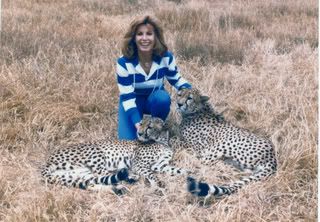
There’s an incredible actress doing amazing work in Africa with the William Holden Wildlife Foundation (http://www.whwf.org/) and, no, it’s not Angelina Jolie. Stefanie Powers,-- another gorgeous, legendary actress whose most recognizable work was her role as Jennifer in the TV show “Hart to Hart “-- is working just as hard without recognition or press coverage. That’s about to change. Stefanie Powers deserves tremendous recognition for the work she is doing on behalf of animals worldwide.
A little background first -- For those of you who don’t know who Bill Holden was, his illustrious acting career spanned over 40 years and including nearly 80 films. He won an Oscar for “Stalag 17”, and was the number one box office star for many years, but his most important role he took on was as conservationist and founder of the Mt. Kenya Game Ranch. Unfortunately, he died too early in 1981 and left his work unfinished.
Fortunately, Holden brought the love of his life, Stefanie Powers, to Africa for the first time in 1973. Stefanie now serves as President. According to her bio, she is also involved with several American zoos -- the Cincinnati Zoo, Zoo Atlanta and the Los Angeles Zoo) where she works with species survival programs and is a frequent keynote speaker for causes dear to her heart such as Farm Sanctuary (humane treatment for farmed animals) and the Bushmeat Crisis. She has also been honored by The Explorers Club with its Lowell Thomas Award for her conservation efforts.
Talk to me about your love of animals when you were growing up.
My stepfather, Jack Robinson, raised racehorses and, in those days, Hollywood Park had an infield with monkeys, geese, exotic turkeys and chickens and all sorts of things. They wanted to do something else with the park and Jack wanted to know what would happen to the animals and he took them. He had his own mini zoo on his ranch with all of these funny creatures that I grew up with. Anything that dropped out of a tree got rescued.
(Later, when the budding actress was in her 20s, she walked into a pet shop and saw a small bear.)
It was a Malaysian Sun Bear and I said, ‘You can’t have a bear!” and I told them if someone buys this bear and it gets big, they won’t take full responsibility -- and I’m lecturing them, so the man says ‘Why don’t you buy it?“ And I said, “Alright, I will!’
My stepfather believed in tough love. I wanted a horse, so he took me to the slaughterhouse and although I didn’t see them being slaughtered, I saw a young and old and beautiful horses. He said, “If you don’t want your horse to wind up here, then you have to always take full responsibility for animals. If you are not prepared, than you can’t have one. Whatever he did to me, it’s lasted throughout my lifetime. I have lots of horses -- I buy them but I don’t sell them. It was a tough lesson, but it was right.
(Stefanie owned her bear for 18 years.)
It led me into the world of exotics, where I knew all the vets. When I would go out of town Ralph Helfer (famed Hollywood animal trainer) would take care of the bear while I did a movie. I didn‘t think it would unfold the way it did, but it‘s become a very important part of my life.
What did you see on your first safari trip with Bill ?
The ranch that Bill had started with his partner, Don Hunt, was in the business of capturing animals and sending them to zoos and parks for captive breeding for conservation work -- long before the word conservation was even in people’s lexicon. At that time, the ranch was involved with a translocation project with the Grevy Zebra which is unique to Kenya that was being poached out of existence in the north of Kenya. The Game Department was interested in trying to move the substantial amount of them to the south to Savo East and West game park, which was run by game warden Billy Woodley. The best capture unit capable of doing it was Bill and Don. So for three years, they had a camp in the north of the country where they would capture Grevy Zebras, leave them in the compound to habituate and those who didn’t were released. When they got a pretty good herd, they moved them. So, my first safari was right into the fire -- we arrived, got in cars and drove for six hours where the camp was.
Many of us don’t even know this stuff goes on -- why is that?
It’s surprising how ignorant we are, given all of the information we have access to. I feel in some way, because we have so much access to information, we value it less and we turn on Animal Planet and National Geographic and see the documentaries on wildlife and I think because we see someone else doing something about it on television, they don’t have to get involved and every once in a while it becomes fashionable to worry about the environment and it’s fashionable now to worry again and I’ve seen the trend come and go. We’re not voting with our pocketbook, demanding ever increasingly hybridized vehicles simply because we won’t buy anything but that. Until we do, nobody is going to moved to produce that sort of stuff.
You had an emotional experience -- do you think we’re missing out on that and that is that would move us to do something?
We have enough opportunities in our own country. They visit national parks, but throw rubbish. Hiking trails are full of rubbish -- who did that? What is it about our lack of concern -- I don’t know how you jar people out of their lethargy. The extinction of species is not a natural phenomenon -- it’s our fault. What kind of a species are we that keep breeding and can’t take care of the children we have? How much stuff do we really need?
What is the number one issue in Kenya?
Loss of habitat for animals. It’s also loss of habitat for people -- overpopulation, misuse of the environment, poor farming methods and overuse of toxic chemicals, rendering vast acres of land unusable to man and beast. One thing we are deeply involved with at the William Holden Wildlife Education Center is alternatives to loss of habitat. We teach alternative methods to habitats so human beings can get better use of the small plots of land and not go into areas where wildlife is competing with them.
(The William Holden Wildlife Education Center spreads over 15 acres of land on the slopes of Mt. Kenya, near the Mt. Kenya Safari Club and adjacent to the Mt. Kenya Game Ranch. The Center houses a youth hostel, lecture hall/library, audio-visual facilities, llama compound, fish farm, tree nursery, bio-gas and solar energy installations. It applies practical conservation methods along with educational programs designed specifically for each group. The center currently serves 10,000 students a year.)
Are toxic chemicals a problem in Africa?
Well, a lot of toxic chemicals that get outlawed in America get exported to the third world. DDT was exported to Mexico from the US and now we’re reimporting food from Mexico. It’s all coming back on us. We are naïve because we think once it’s out of our hands it’s done and over with. We also think the garbage men just pick it up and it’s gone and we shouldn’t be responsible for separating our biodegradable. I have a compost machine; the greatest think I produce is dirt because I have so much cuttings -- from the trees, kitchen, etc.
But if we can’t even focus on what we have here, how can we focus on what’s going on in Africa or other countries?
We have the North American wild horse -- it’s a perilous situation. The Bureau of Land Management wants the wild horses off of federal lands because they are being pressured by senators whose constituency are cattle/beef growers and they want cheaper grazing land because then they can command cheaeper prices of meat. I‘m a vegetarian and we eat too many animal products as it is. It’s not natural for us to eat so many animal products -- eggs, cheese, fish, meat. How many years is it going to take before we realize we won’t have any fish in the sea in our lifetime?! It’s no longer a question of saying “we have to do this for our future generation,” but it is happening in OUR lifetime. We have to do this now! It is happening.
How do we get involved in your causes?
If people are interested in domestic causes I’m very involved with the wild horse situation. There are a number of good organizations for the translocation and the purchase and the maintenance of them You can help raise money -- get kids together to raise money for those organizations they want to support -- $5 is still $5, so nothing is too small especially when you are trying to feed horses.
What’s on the horizon for you?
I‘m on the Jaguar Conservation Trust. (After our interview a few months ago, Stefanie went to India -- Gujarat and she talks about what she was going to be doing.) I’m on my way to India to the former hunting grounds of the ruler of that area. It was made into a sanctuary for the very rare Asiatic lion -- there are maybe 200 left. The men who are spearheading the effort visited our education center three times last year and want to see if we can replicate our education center and outreach program into communities in their sanctuary, so I’m keynote speaker.
(Jaguar North America announced the formation of the Jaguar Conservation Trust back on April 15, 2003. It was a new campaign to assist in the effort of preserving the company’s namesake. The Trust provides grands and funding for projects that promote the preservation of the jaguar and its habitat. Stefanie aids in the creation of a full-spectrum conservation program.)
With just a $35 a year membership in the Trust we can carry on the work done by local people in Belize, Guatemala and Costa Rica -- they are active local groups -- small groups of indigenous of native tribal bases living in remote areas who regard the jaguar as a spiritual being doing tremendous work trying to educate people.)
In her bio, Stefanie says “The Foundation is a large commitment, but it’s not something I entered into without understanding the full impact of the obligation. It’s a lifelong commitment that sometimes monopolizes one hundred percent of my time.” And, according to Powers, she’ll continue working because it’s, “what I need to do to keep doing the work in Africa.” We are eternally grateful for her work, but she needs our help. Check out the website and see if there is any way that you can help. Me? I’m going to order some of the adorable baby monkey cards! They are my personal favorite animal. What’s yours?
----
A few months ago, I had the privilege of hearing about the launch of Jacob’s Cure and the story of Jacob and his mom, Jordana Holovach. Please take a few minutes out of your day to visit their site and learn more about this incurable condition.
On May 31st, they launched Jacob’s Cure Smiley Bag by Babydish. Jacob’s Cure is a foundation founded by Jacob’s mother, Jordana Holovach to help find a cure for Canavan Disease. Jacob has suffered from this disease since birth and there is no cure. Babydish designed The Smiley Bag, after Jacob’s smile and will donate 40% of each sale to help fight this deadly disease.
At the home of Lisa Hallerman, celebrities and VIPs got together to learn more about this illness. Elizabeth Banks, Lake Bell, AJ Cook, Julie Bowen, Alicia Coppola, Rachel Harris, Maria Menounos, Brooke Mueller and Adriane Palnicki were guests of this intimate affair.The event was hosted by Boston Legal’s Julie Bowen, who just gave birth to her son 7 weeks ago. She told many of the guests how moved she was about Jacob’s story, that she agreed to host two days after giving birth. She was telling the story of how she went into labor on set, while pretending to go into labor to fool her castmates.
About Jacob’s Cure - Jacob's Cure is a non-profit foundation dedicated to raising awareness and the funds necessary to cure Canavan Disease, a fatal genetic neurological disorder that affects children at birth. Founded in September 2000 by Jordana Holovach with the hope of saving her son's life, Jacob's Cure allocates 95% of funds raised to research in gene-therapy, stem cell transplantation, pharmacology, and a greater basic understanding of the disease. Jacob's Cure is responsible for funding the Canavan Research lab at Cooper Hospital/Robert Wood Johnson. Its efforts to date have resulted in successful gene-therapy trials and pharmaceutical interventions that have stopped the progression of the disease in Canavan children worldwide.
40% of sales from the Smiley Bag will benefit Jacob's Cure and the fight against Canavan Disease. The bag can be purchased at www.babydish.com. Canavan Disease is a fatal genetic brain disorder that affects children at birth. For more information, please visit www.jacobscure.org.
About BabyDish - BabyDish, the creator of the BabyBeReady Diaper Bag Survival Kit was founded in 2006 by Stacie Mindich-Jordan, a mother of two who created the only pre-packed diaper bag filled with 10 of baby’s most essential items. A portion of all proceeds goes to cancer organizations and Jacob’s Cure.
COMING UP: ON JULY 11TH -- DOUG CHRISTIE, NBA SUPERSTAR AND HIS WIFE JACKIE TALK ABOUT HOW THEY LOVE GIVING BACK TO THE COMMUNITY.

